First
Last
email@email.com
Quant Insight: Sector Rotation and Re-Leveraging Amidst "Extreme Fear"
Market
June 26, 2026


Skye
Decoding institutional Liquidity Sweeps
Excerpt: Global tech faced heavy volatility triggered by a violent KOSPI reversal, driving sentiment into "Extreme Fear." However, ArakawaQuant’s multi-factor matrix captured a powerful rotation into cyclical industrials and defensive healthcare, proving the resilience of a data-driven barbell strategy.
Introduction: Finding Systematic Certainty in Peak Volatility
The global financial markets started the week like they were launched out of a cannon. A violent reversal in South Korea’s KOSPI quickly rippled into U.S. technology and semiconductor sectors, triggering a wave of heavy profit-taking. This sharp cascade pushed U.S. market sentiment from "Greed" just a month ago straight into "Extreme Fear" territory.
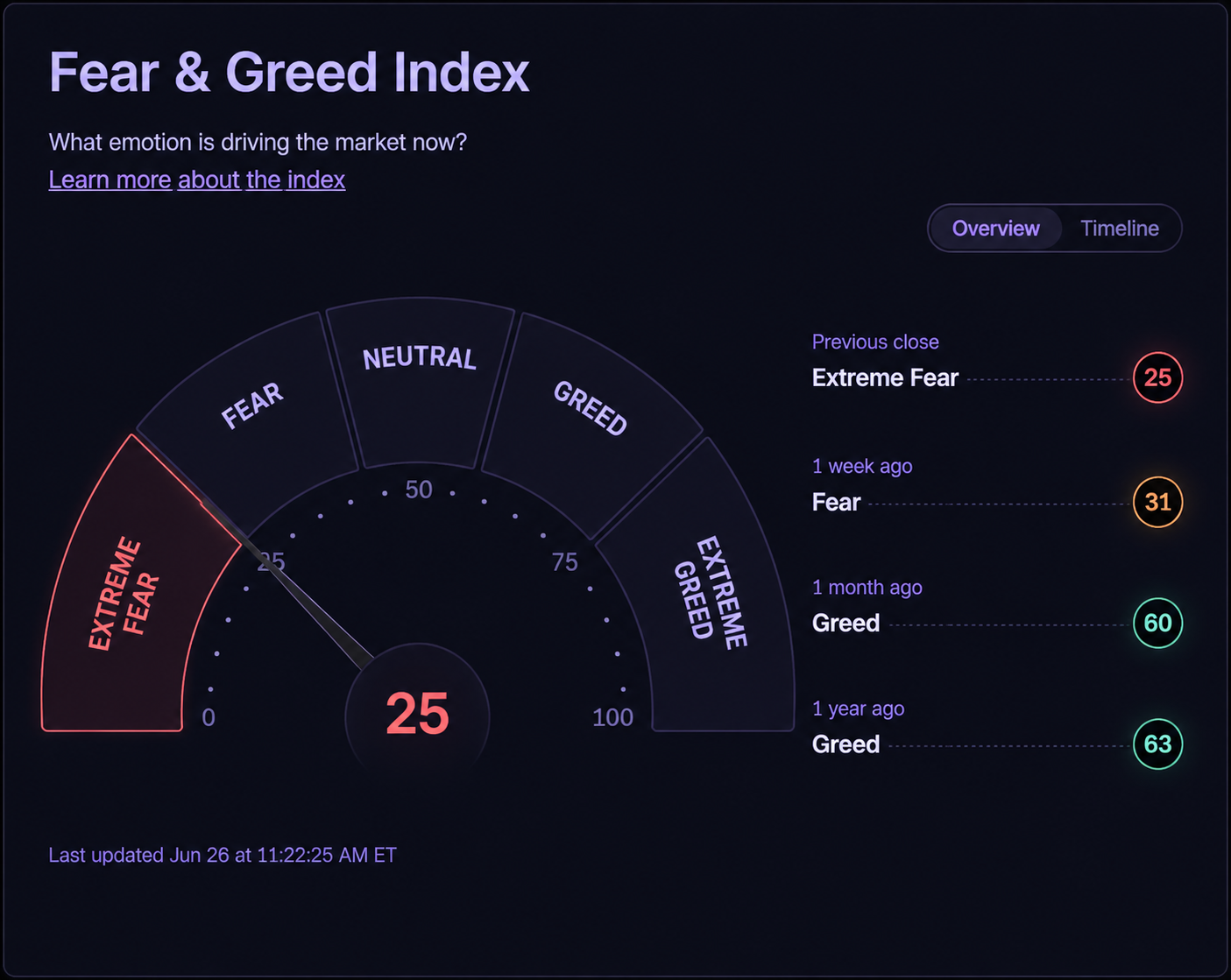
Yet, under this volatile macro backdrop, the ArakawaQuant Core Selection Matrix delivered robust resilience. Guided by our systematic multi-factor risk model, powerful gains in cyclical industrials and defensive healthcare successfully neutralized drawdowns in highly-valued growth names. Historical data shows that sentiment-driven, irrational sell-offs often present optimal entry points for high-factor-scoring equities to unleash their long-term operating leverage.
Macro Factors & Sector Dynamics: Industrials Breakout vs. Tech Capex Anxiety
U.S. Equities delivered a highly bifurcated performance this week. The underlying mechanism was a clear defensive rotation from richly valued mega-cap tech into value and cash-generative sectors:
Quantitative Breakout in Industrials: As investor confidence strengthened regarding U.S. manufacturing and business investment, economically sensitive sectors surged. The S&P 500 Industrials Index (SP500-20) climbed to an all-time high on Thursday, gaining up to 3.2%. The advance showcased remarkable breadth, with 71 out of its 80 constituents moving higher. Market leaders with strong pricing power—such as Xylem (XYL), Caterpillar (CAT), Hubbell (HUBB), and Ingersoll Rand (IR)—anchored the upward momentum.
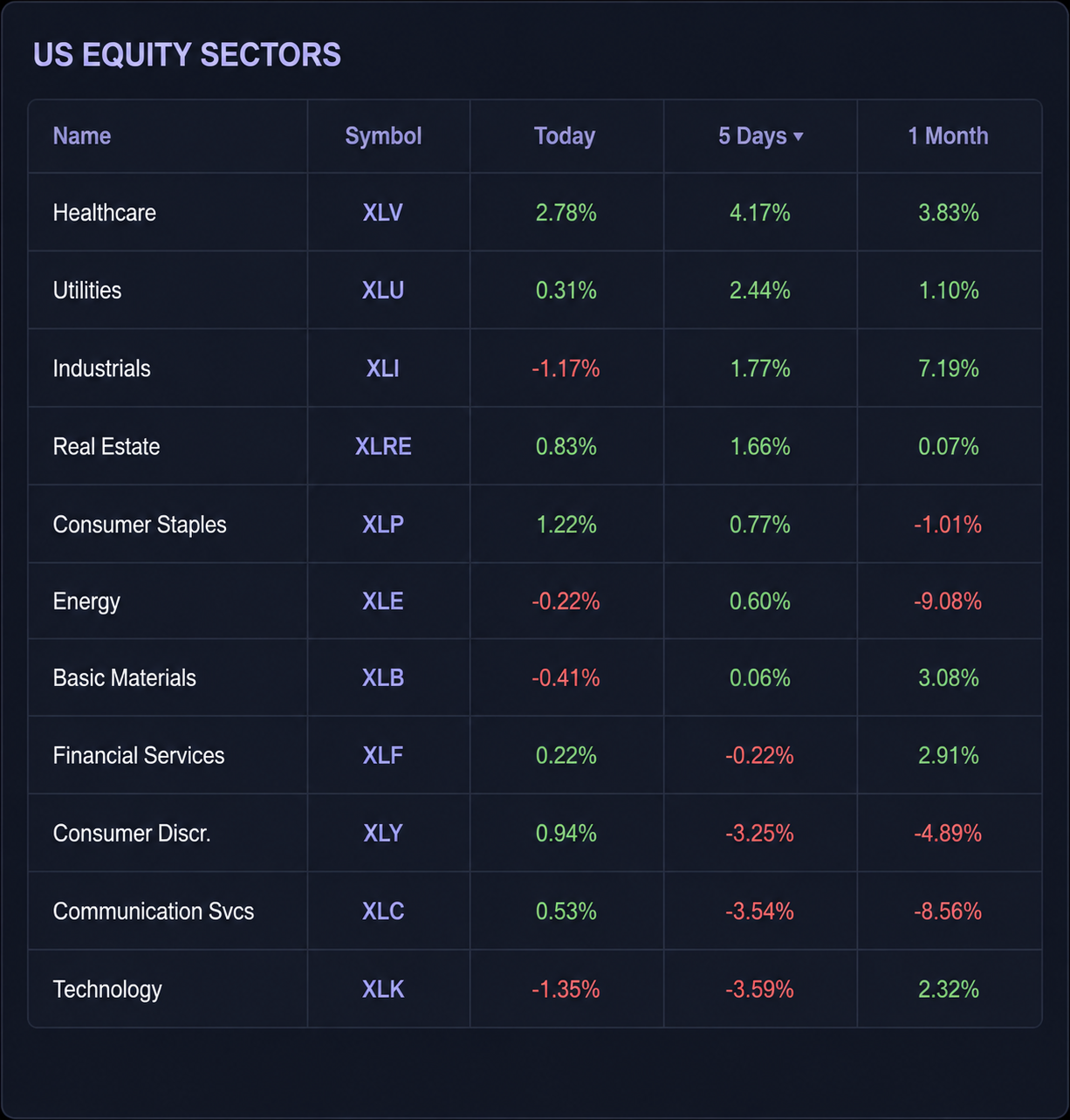
Semiconductor Divergence & Capex Concerns: While Micron (MU) skyrocketed nearly 17% on back of formidable Q3 FY26 results and robust HBM guidance, and Qualcomm (QCOM) steadied on handset recovery and on-device AI themes, tech indices remained heavily pressured. Wall Street is increasingly questioning the near-term ROI of aggressive AI-related Capex and escalating hardware compute costs. Apple (AAPL) added to the anxiety, sliding over 6% after announcing steep price hikes across Macs and iPads to offset component costs, stoking demand fears.
Resilient Macro Underpinnings: From a quantitative macro perspective, U.S. Q1 GDP was revised upward significantly to 2.1% (from 1.6%), May core PCE printed right in line with consensus, and personal income/spending both beat expectations. Although the Chicago Fed National Activity Index slipped slightly, the aggregate macro picture points to solid growth that is resilient but not overheated.
Risk Management: The Mathematical Edge of a Barbell Approach
In systematic trading, structured risk management always takes precedence over individual win rates. Amidst elevated fear, we strongly advocate an institutional Barbell Approach:
Pair high-growth, high-conviction AI and hardware upstream suppliers (supported by technological moats and positive revisions, like ICHR and SNDK) on one end, with durable, high-yield defensive dividend payers on the other. The high-yield quantitative basket currently monitored by ArakawaQuant offers an average forward yield of 1.46%, comfortably outperforming the S&P 500’s 1.04%. This structure cushions drawdowns during sharp sentiment swings while fully preserving aggregate portfolio upside velocity.
Forward Optimization and Outlook
Looking ahead to next week, the market's primary focus shifts toward fresh labor market quantitative data—specifically ADP employment and initial jobless claims. These metrics will serve as critical signals for wage inflation trends and structural hiring momentum.
The ArakawaQuant core matrix remains dynamically optimized. Our quantitative engine continuously re-scrapes thousands of U.S. equities and ADRs based on real-time factor alignment, mechanically shedding degraded positions. We continue to systematically isolate market noise, utilizing institutional-grade data to construct your core defensive line for long-term alpha.
In an era of information overflow, alpha lies in asymmetric execution, not intuitive consensus.
Skye
SMC Market Analyst
Subscribe to our newsletter
Get the insider insights you need to scale, straight to your inbox.



Decode the Market. Quantify Your Edge.
Elite quantitative models and real-time execution signals. Trade with institutional power.

Copyright © 2026 Hong Kong Arakawa Limited. All rights reserved.


%2C%20Color%3DNegative.svg)