First
Last
email@email.com
Quantitative Equity Research: Sterling Infrastructure (STRL) Surges +40% on Blowout Q1 Earnings as AI E-Infrastructure Scaling Drives Re-rating
Market
May 5, 2026


Ada
Liquidity Architect & Institutional Order Flow Analyst
Executive Summary
- Blowout Performance: Sterling Infrastructure, Inc. (STRL) emerged as a major market mover, surging over 40% in a single session following an exceptional Q1 2026 financial disclosure that significantly exceeded institutional consensus expectations.
- AI Infrastructure Nexus: Beyond its core transportation and building solutions divisions, the issuer has established itself as a critical provider of advanced e-infrastructure, data center foundations, and semiconductor fabrication facilities, capturing massive capital expenditure from the ongoing AI buildout.
- Core Matrix Highlights: The company delivered record quarterly revenue of $825.7 million, exceeding consensus estimates by $233.7 million, while beating diluted EPS expectations by $1.40. Company-wide margins expanded past 20% on the back of a 107% surge in Adjusted EBITDA.
- Compounding Systematic Alpha: Within the Arakawa Quant framework, STRL represents a high-conviction repeat selection, alongside Powell Industries (POWL) and Celestica (CLS), with each position generating compounding structural gains exceeding 1,000% across multi-year systematic hold cycles.
Macro & Fundamental Analysis: Secular AI Infrastructure Capex Driving Exponential Backlog
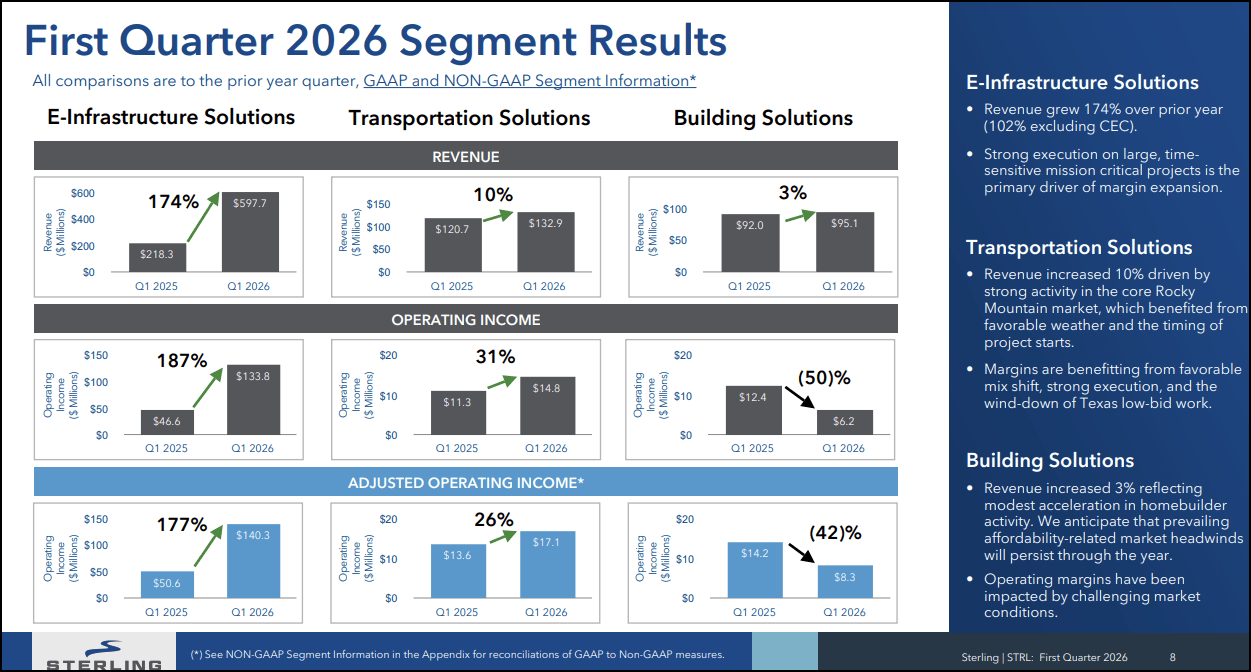
Sterling Infrastructure (STRL) exemplifies how micro-cap and mid-cap industrial executors can capture multi-year structural tailwinds by aligning operations with secular technology megatrends. While traditional industrial data rooms focused exclusively on civil transportation and structural building assets, the Arakawa Quant model flagged STRL due to its rapidly expanding footprint in the high-margin data center and semiconductor fabrication facility development space.
The issuer's Q1 2026 disclosure confirmed an extraordinary operational inflection, prompted by an accelerated corporate capital expenditure cycle among hyperscaler tech networks. The specialized E-Infrastructure solutions segment expanded revenue by 174% year-over-year, lifting total corporate gross margins above the 20% threshold.
This immense volume acceleration allowed management to aggressively raise its FY2026 top- and bottom-line guidance. According to CEO Joe Cutillo, the high-probability future-phase project pipeline has expanded beyond $1.3 billion, securing a highly visible multi-year cash flow runway that remains insulated from broader macroeconomic cyclicality.
Arakawa Quant Multi-Factor Matrix Alignment
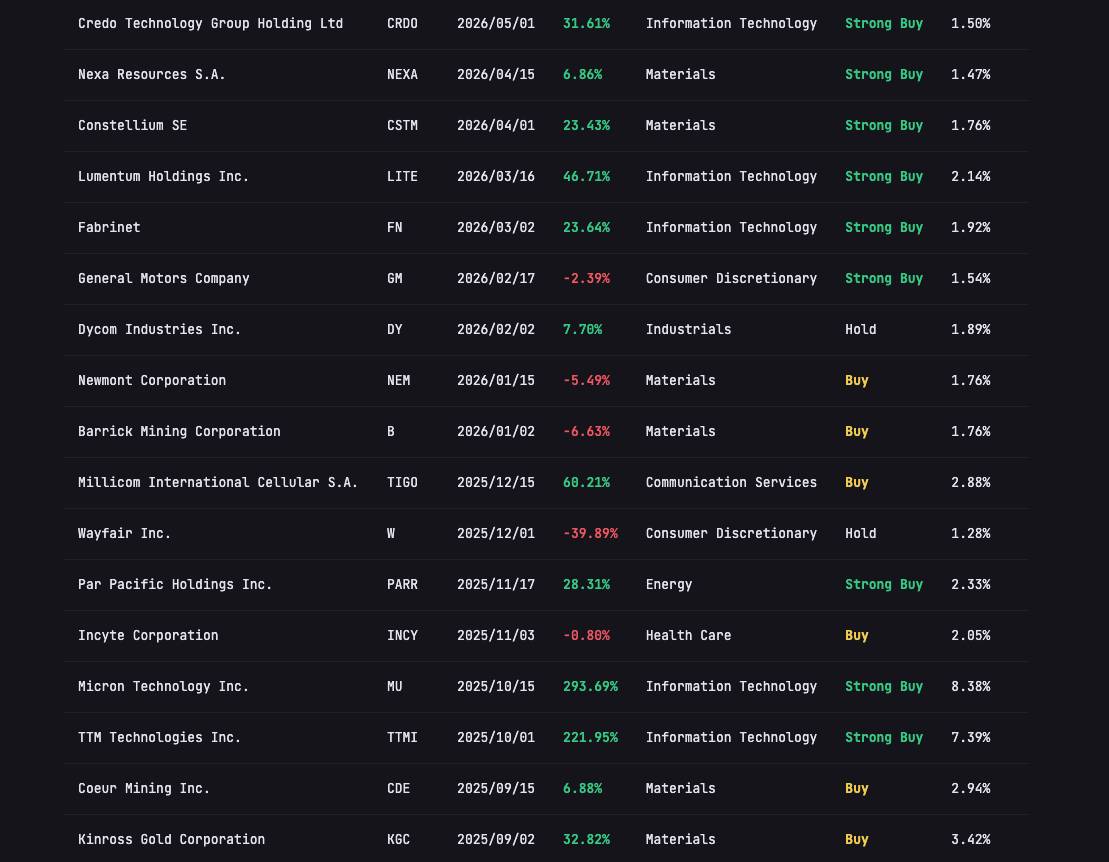
The quantitative health of the issuer supports its position as an exceptional fundamental outperformer, despite traditional valuation metrics displaying compressed near-term premiums.
From a profitability perspective, STRL commands a best-in-class 30% Return on Equity (ROE), outperforming the broader industrial sector median by over 130%. This exceptional cash-generation capability triggered a unanimous upward revision cycle over the trailing 90 days, with three institutional analysts raising forward models against zero downward adjustments.
Crucially, while the stock's parabolic trajectory has pushed its technical multiples into an extended valuation premium, the mathematical governance of the Arakawa Quant protocol classifies the asset under a strict "Hold" mandate. In systematic asset allocation, a transition to a neutral holding posture reflects asset retention rather than liquidation. Historically, when the asset entered a similar consolidation phase in late 2025 at a market price of $326.60, the underlying multi-factor support preserved its position in the portfolio, allowing institutional capital to fully capture the subsequent migration to $780.42.
Institutional Portfolio Rebalancing Framework
To enforce structural alpha preservation and eliminate style drift, our quantitative engine operates under strict execution mandates:
- Systematic Liquidation: Any active position that breaches the minimum multi-factor threshold is automatically marked for immediate, non-discretionary market liquidation.
- Duration Constraints: Holdings that display structural momentum stagnation within a neutral consolidation channel for more than 180 trading days are systematically pruned.
- Pro-Rata Capital Deployment: Liquidated cash balances are immediately and symmetrically reinvested across the remaining active components within the quant-optimized portfolio, maximizing compounding efficacy and factor purity.
Alpha is no longer found in raw data, but in the unseen structural correlations buried within institutional order flows
Ada
Lead Quantitative Research Analyst
Subscribe to our newsletter
Get the insider insights you need to scale, straight to your inbox.




Decode the Market. Quantify Your Edge.
Elite quantitative models and real-time execution signals. Trade with institutional power.

Copyright © 2026 Hong Kong Arakawa Limited. All rights reserved.


%2C%20Color%3DNegative.svg)