
搜索
Quantitative Equity Research: Systematic Divestment of SkyWest (SKYW) as Cross-Factor Momentum and Revisions Flash Sell Signals


Executive Summary
Portfolio Divestment: Despite a headline earnings beat, SkyWest, Inc. (SKYW) has been systematically downgraded to a Sell rating within the quantitative framework due to deteriorating growth factors, decelerating price momentum, and highly adverse EPS revisions.
Structural Headwinds: Elevated structural costs—specifically aviation fuel, specialized labor, and fleet maintenance—coupled with reduced summer block-hour production from partner capacity constraints, are heavily compressing forward operating margins.
Factor Decay: Downward revisions to forward EPS consensus have triggered a severe decay in both sentiment and price momentum metrics, causing the equity to significantly underperform its sector peers.
Systematic Discipline: Although valuation and immediate profitability metrics remain fundamentally insulated, strict adherence to a rules-based, quantitative factor mandate necessitates the absolute removal of the position upon cross-factor degradation.
Macro & Fundamental Assessment: Operational Pressures Grounding Growth
SkyWest, Inc. (SKYW), a leading regional airline operator contracting with legacy network carriers across North America, is facing a confluence of microeconomic and structural headwinds.
While the issuer reported headline beats on both top- and bottom-line estimates for Q1 2026, a granular cross-sectional analysis reveals structural deceleration. Quarter-over-quarter growth remained highly muted: revenue expanded by a modest 7% year-over-year (Y/Y), while net income compressed flatly to approximately $102 million.
The underlying operational drag is driven by sustained supply-side pressures. Geopolitical risk premiums have kept aviation fuel costs elevated, while partner carriers' capacity and schedule adjustments have constrained summer block-hour production.
Compounding these volume restrictions are sticky labor contracts and escalating airframe maintenance cycles. These variables have forced institutional desks to downwardly revise FY2026 EPS models. Furthermore, trailing twelve-month (TTM) cash flow expansion has been structurally limited by aggressive debt-service allocations and capital deployment toward share buybacks, depressing the equity's Growth factor grade to a bottom-quartile position relative to the broader Industrials sector.
Arakawa Quant Multi-Factor Analysis & Decay Reversal
The quantitative deterioration of the issuer is most vividly captured by the sharp contraction in institutional earnings sentiment and price trend velocity.
Within the Arakawa Quant research framework, the Forward EPS Revisions factor for SkyWest (SKYW) exhibited severe capitulation over a trailing 90-day window. This rapid deceleration was driven by an absolute shift in institutional consensus, marked by six distinct sell-side analysts executing consecutive downward adjustments to the issuer's forward earnings expectations, contrasted against zero upward revisions.
This negative revision cycle has fundamentally broken market sentiment, triggering an acceleration in downward price momentum. On a trailing three-month basis, SKYW has generated a negative return of $$-18.48\$$, vastly underperforming the broader sector median drawdown of $$-4.47\$$.
Paradoxically, specific standalone metrics remain fundamentally solid. The equity continues to exhibit an attractive entry valuation based on historical discounted cash flow metrics. Similarly, current trailing profitability remains sticky, characterized by an Return on Equity (ROE) tracking 32% above the sector median and a TTM EBITDA margin holding at 23%.
However, the core thesis of the Arakawa Quant protocol is rooted in rules-based, mathematical execution rather than qualitative hope. When a systematic multi-factor score breaks beneath the investment-grade threshold into a clear Sell regime, behavioral bias must be eliminated, and the asset must be immediately liquidated to preserve capital.
Institutional Execution and Systematic Rebalancing Mandate
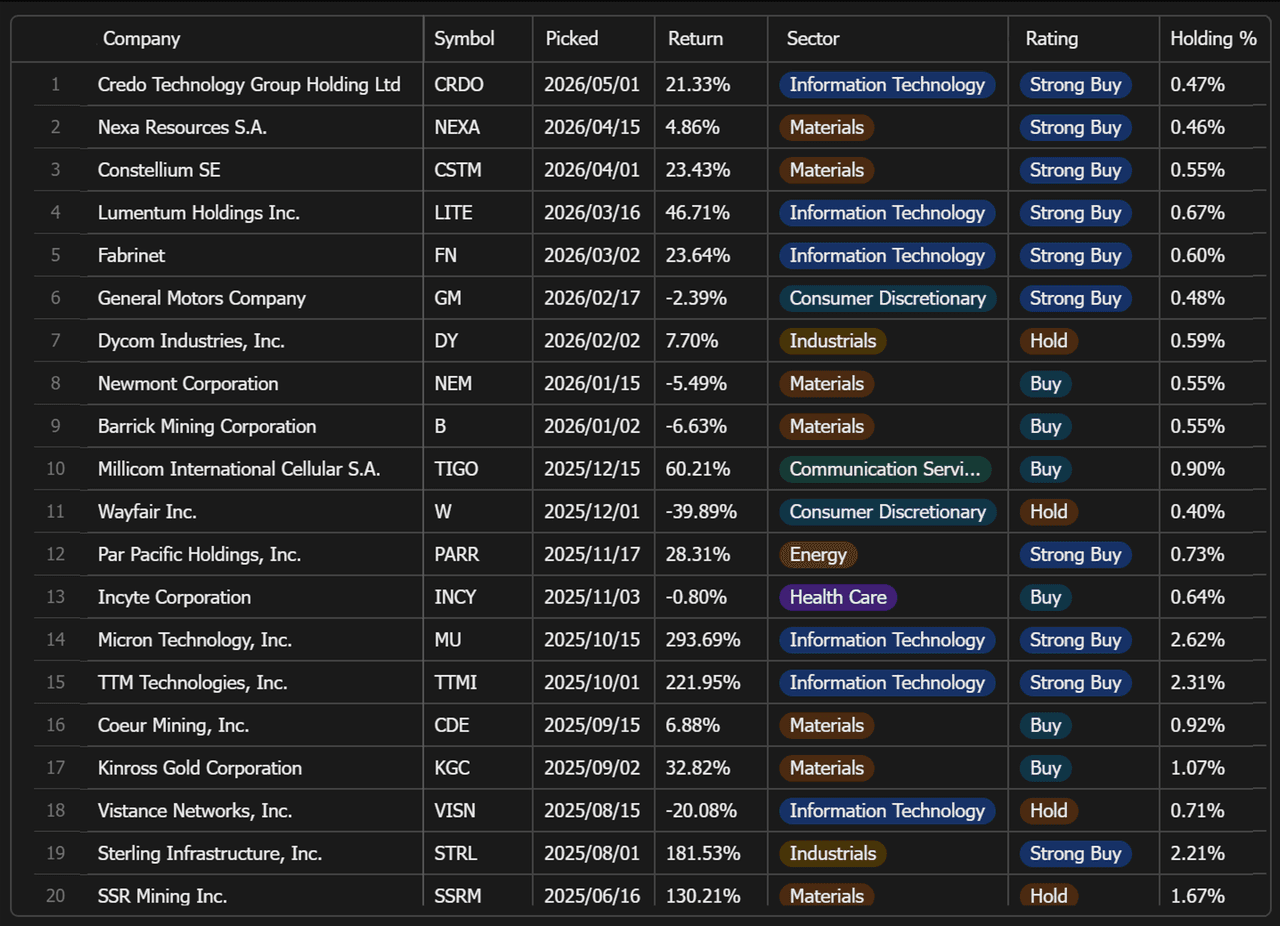
To maintain absolute strategy integrity and prevent style drift, the quantitative model enforces strict onboarding and offboarding governance:
Systematic Liquidation: Any open position that undergoes factor degradation causing its Arakawa Quant rating to drop to a Sell or Strong Sell is immediately exited.
Time-Bound Optimization: Positions that consolidate within a neutral Hold classification for greater than 180 trading days are systematically pruned to prevent capital stagnation.
Pro-Rata Reallocation: The liquidity generated from systematic divestments is immediately and equally redistributed across the remaining active, high-conviction components within the quant-approved portfolio, maximizing compounding efficiency and factor integrity.