First
Last
email@email.com
Bank of America: Strong Earnings, Attractive Income, and Further Upside Potential
Arakawa Quant Picks


Skye
Decoding Institutional Liquidity Sweeps
Summary
- Bank of America delivered broad-based growth in Q2 2026, with revenue increasing 15% year over year to $31.6 billion and EPS rising 34% to $1.21.
- All major business segments contributed to the expansion, supported by stronger net interest income, investment banking activity, wealth management, and trading revenue.
- The company continues to demonstrate strong quantitative characteristics, including A-range grades for profitability, momentum, and earnings revisions, with 18 upward FY1 estimate revisions and no downward revisions over the past 90 days.
- Bank of America offers a 1.98% forward dividend yield, supported by robust cash generation, a conservative payout profile, and a CET1 capital ratio of 11.2%.
- Its asset-sensitive balance sheet could provide additional support if interest rates remain elevated, while the bank's scale and diversified revenue base provide resilience across different market environments.
- The stock combines improving earnings, strong analyst sentiment, attractive cash-flow characteristics, and shareholder income, making it an interesting candidate for investors seeking both quality and upside potential.
Business Overview
Bank of America Corporation (BAC) is one of the world's largest financial institutions, headquartered in Charlotte, North Carolina, with approximately $3.5 trillion in total assets. The company operates across consumer banking, wealth management, commercial banking, investment banking, and global markets, giving it exposure to a broad range of financial activities and economic conditions.
Bank of America currently ranks as the #1 Quant-rated Diversified Bank stock and #2 Quant-rated Financials stock, reflecting the strength of its underlying fundamentals, profitability, momentum, and earnings expectations.
The company's history dates back to 1904, when Amadeo P. Giannini founded the Bank of Italy in San Francisco. The modern Bank of America Corporation was established following NationsBank's acquisition of BankAmerica in 1998. Today, the company operates primarily across the United States while serving clients in approximately 35 countries.
Its business is organized around four major areas.
Consumer Banking is the largest division, serving more than 69 million consumer and small-business clients through approximately 3,500 financial centers and 15,000 ATMs. The segment provides traditional banking services, credit cards, deposits, lending products, and other financial solutions.
Global Wealth and Investment Management, which includes Merrill and Bank of America Private Bank, represents another major source of recurring revenue. The business manages approximately $4.9 trillion in client balances and $2.3 trillion in assets under management, benefiting from long-term growth in household wealth and demand for investment services.
Global Banking provides commercial and corporate banking, treasury management, lending, and investment banking services to middle-market companies and large multinational corporations. Meanwhile, Global Markets provides institutional clients with sales and trading capabilities across fixed income, currencies, commodities, and equities.
This diversified structure is an important part of Bank of America's investment case. The company competes with other major U.S. financial institutions such as JPMorgan Chase and Wells Fargo, while also facing competition from regional banks, investment banks, and financial technology companies.
However, Bank of America's enormous customer base, scale, technology infrastructure, and diversified revenue streams provide meaningful competitive advantages. The company has also invested heavily in artificial intelligence and technology, with more than 300 approved AI use cases designed to improve customer engagement, productivity, risk management, and operational efficiency.
Investment Thesis
Bank of America's latest results demonstrate that the company is benefiting from broad-based organic growth while maintaining strong operating discipline.
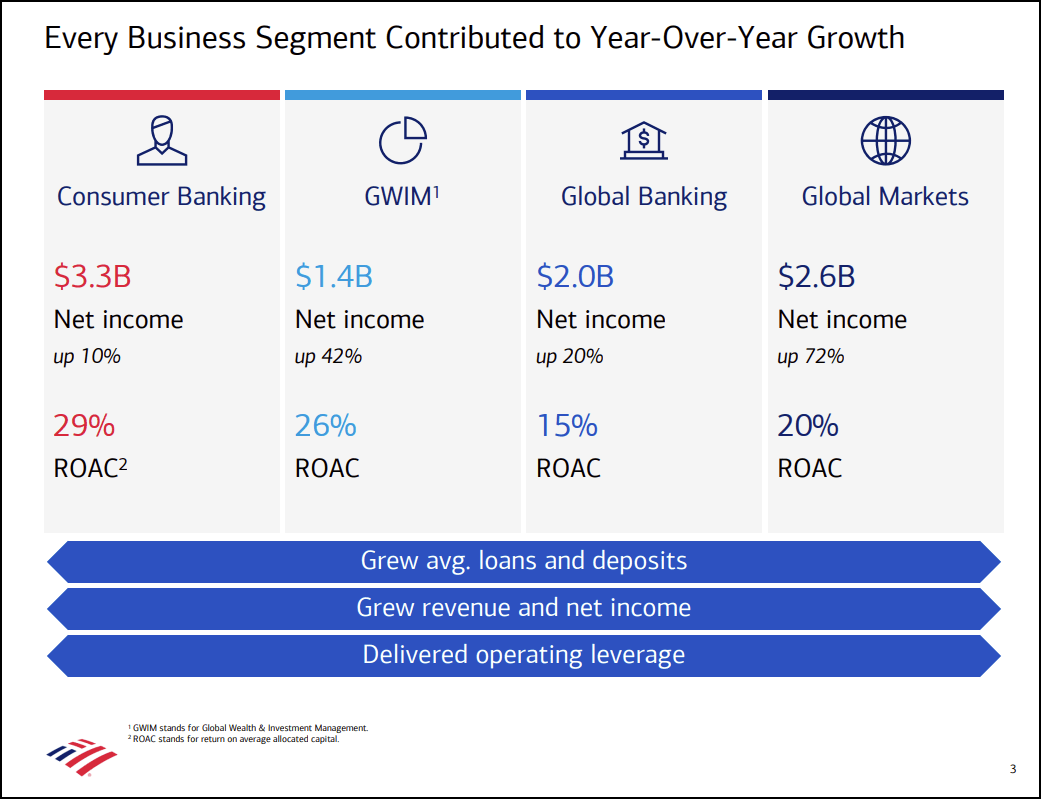
Every major business segment delivered double-digit year-over-year net income growth in Q2 2026. This is important because the company's earnings expansion is not dependent on a single business line or one temporary market trend.
Global Markets recorded its 17th consecutive quarter of year-over-year sales and trading revenue growth, while investment banking benefited from strong merger and acquisition activity during the first half of the year. The continued expansion of AI-related capital expenditure is also creating opportunities across equity issuance, debt financing, and M&A activity.
As companies invest heavily in data centers, computing infrastructure, software, and other AI-related projects, the financing requirements associated with this investment cycle can benefit large financial institutions such as Bank of America.
The bank's balance sheet also remains relatively sensitive to changes in interest rates. Under its current deposit assumptions, management estimates that a 100-basis-point parallel upward shift relative to the June 30 forward curve could increase net interest income by approximately $1 billion over the following 12 months.
The reason is relatively straightforward: higher yields on interest-earning assets could rise faster than the associated increase in funding costs, supporting net interest income.
This creates an additional potential earnings catalyst if monetary policy remains restrictive for longer than currently expected.
From a quantitative perspective, Bank of America also presents a strong profile. The company receives A-range grades for profitability, momentum, and revisions. While its valuation is not universally cheap compared with other financial companies, its growth profile remains healthy, with a B+ Growth Grade.
The combination of earnings growth, improving analyst expectations, strong profitability, and shareholder income provides a relatively balanced investment case.
Bank of America Growth and Profitability
Bank of America's second-quarter performance showed strength across nearly every major financial metric.
Revenue increased 15% year over year to $31.6 billion, with all operating segments contributing to the improvement.
Average deposits increased to $2.02 trillion, extending the company's record of consecutive quarterly deposit growth to 12 quarters. Average loans and leases also increased 8% to approximately $1.2 trillion, driven primarily by commercial loan growth.
Net interest income increased 9% to $16.2 billion, benefiting from loan and deposit growth, fixed-rate asset repricing, and continued activity within Global Markets.
Fee-based businesses were also particularly strong. Noninterest income increased 22%, while investment-banking fees jumped 50% to more than $2.1 billion. Sales and trading revenue increased 33% to $7.2 billion, while investment and brokerage fees grew 18%.
Consumer activity remained healthy as well, with credit-card spending increasing 9%.
Meanwhile, Bank of America's wealth-management franchise continued expanding. Client balances reached a record $4.9 trillion, while assets under management increased 17% to $2.3 trillion.
The breadth of these results is important. Rather than relying solely on higher interest income, the company is generating growth from lending, deposits, investment banking, trading, wealth management, and consumer activity simultaneously.
From a quantitative perspective, Bank of America's forward and long-term EPS growth metrics are both approximately 36% above the sector median. Forward ROE growth stands at 12.9%, compared with only 3.2% for the broader financial sector.
Profitability improved alongside revenue growth.
Net income increased 27% year over year to $9.1 billion, while EPS increased 34% to $1.21. Revenue growth also outpaced expense growth, generating approximately 660 basis points of operating leverage and improving the efficiency ratio to 59%.
The performance of individual business units further demonstrates the strength of the franchise.
Consumer Banking generated a 29% return on allocated capital, while Global Wealth and Investment Management produced a 26% return and a pretax margin above 27%. Global Banking achieved a 15% return on allocated capital, while Global Markets delivered a 20% return.
Consumer Banking's 51% efficiency ratio reflects disciplined expense management, while Global Markets generated 16% operating leverage.
Management has raised its full-year operating leverage outlook to 300-400 basis points, supported by higher net interest income and continued growth in fee-based revenue.
Credit conditions have also remained manageable. Provision expense and net charge-offs were each approximately $1.4 billion, while the company's CET1 ratio remained at 11.2%, comfortably above its 10% minimum requirement.
Bank of America also generated more than $94 billion in cash from operations, equivalent to approximately $31.68 in cash per share, compared with just $7.15 for the sector.
Taken together, these figures demonstrate a business with significant earnings power, strong liquidity, and considerable capacity to continue investing while returning capital to shareholders.
Earnings Revisions, Momentum, and Valuation
One of the most encouraging aspects of the current Bank of America setup is the direction of analyst expectations.
Following the strong second-quarter results and improved management outlook, analysts have become increasingly constructive on the company's earnings trajectory.
During the past 90 days, Bank of America received 18 upward FY1 earnings revisions and zero downward revisions.
This represents a significant improvement in the company's revisions profile, with its rating moving from a C six months ago to an A today.
Strong earnings expectations have also been accompanied by positive price momentum over both the three-month and six-month periods.
For quantitative investors, this combination is particularly relevant. Improving fundamentals are more compelling when they are accompanied by rising analyst expectations and positive market momentum.
Valuation presents a more nuanced picture.
On some conventional measures, Bank of America appears relatively expensive compared with the broader financial sector. However, other metrics indicate that the stock may still offer reasonable value relative to its earnings and cash-flow potential.
Its forward PEG ratio is approximately 19% below the sector average, while its trailing 12-month price-to-cash-flow ratio is approximately 53% below the sector average.
This suggests that although investors are already recognizing some of the company's improvement, the market may not be fully pricing in its combination of earnings growth and cash-generation capacity.
The company's dividend profile provides another component of the investment case.
Bank of America currently offers a 1.98% forward dividend yield, compared with approximately 1.30% for the S&P 500.
More importantly, the dividend is supported by strong cash generation. The company's cash-to-dividend payout ratio is approximately 62% below the sector median, indicating a comparatively conservative payout burden.
For income-oriented investors, this provides an additional source of return while the underlying business continues to grow.
Potential Risks
Despite the strong fundamentals, Bank of America is not without risk.
The first major risk is the economic cycle. A significant slowdown in economic activity could increase credit losses among consumers and businesses, particularly in commercial real estate. Higher loan-loss provisions could then reduce earnings.
Interest rates represent another important variable. While a higher-for-longer environment could benefit the bank's asset-sensitive balance sheet, an aggressive decline in rates or unfavorable changes in deposit pricing could put pressure on net interest income.
Capital-markets activity is another potential source of volatility. A slowdown in M&A, equity issuance, or debt financing could reduce investment-banking fees, while weaker market activity could negatively affect trading and wealth-management revenue.
Bank of America also operates within a heavily regulated industry. Changes in capital requirements, consumer-protection rules, banking regulations, or government policy could affect profitability and operating flexibility.
Additional risks include litigation, cybersecurity incidents, operational disruptions, reputational damage, geopolitical shocks, and counterparty stress.
Market volatility can also have mixed effects. Although higher trading activity may benefit certain parts of Global Markets, extreme market stress can simultaneously reduce asset values, disrupt funding conditions, and weaken client activity.
For investors, these risks reinforce the importance of evaluating Bank of America through a multi-factor framework rather than relying on a single earnings metric or valuation indicator.
Conclusion
Bank of America combines the characteristics of a large-scale financial institution with a strengthening fundamental and quantitative profile.
The company's second-quarter results showed broad-based improvement, with revenue increasing 15% to $31.6 billion, net income rising 27% to $9.1 billion, and EPS increasing 34% to $1.21.
Growth was not concentrated in one area. Net interest income increased, investment banking recovered strongly, trading revenue expanded, wealth-management balances reached record levels, and consumer activity remained resilient.
The company's scale also provides an important competitive advantage. With approximately $3.5 trillion in total assets, 69 million consumer and small-business clients, $4.9 trillion in client balances, and operations across 35 countries, Bank of America has the infrastructure and customer base required to compete across multiple areas of financial services.
From a quantitative perspective, the picture is equally constructive.
The company currently carries A-range grades for profitability, momentum, and earnings revisions. Analysts have issued 18 upward FY1 revisions and no downward revisions over the past 90 days, while the company's EPS growth metrics remain substantially above sector averages.
At the same time, Bank of America's 1.98% forward dividend yield, strong operating cash flow, conservative payout profile, and 11.2% CET1 ratio provide additional support for investors seeking income alongside capital appreciation.
The stock is not without challenges. Economic weakness, falling interest rates, credit losses, regulatory changes, and weaker capital-markets activity could all affect future results. Valuation is also not uniformly inexpensive relative to the financial sector.
Nevertheless, the combination of improving earnings, strong profitability, positive analyst revisions, healthy momentum, significant cash generation, and shareholder returns creates a compelling long-term setup.
For investors using a quantitative approach, Bank of America illustrates why evaluating multiple factors simultaneously can be more informative than relying on a single metric. Earnings growth provides the fundamental foundation, analyst revisions help identify changes in expectations, momentum reflects market confirmation, and valuation determines how much of that improvement may already be reflected in the share price.
At Arakawa Quant, this multi-factor perspective is central to how we evaluate opportunities across global markets. Rather than focusing exclusively on short-term price movements, our framework looks at the interaction between fundamentals, valuation, momentum, earnings expectations, and market conditions to identify companies with stronger risk-adjusted potential.
Bank of America currently stands out because several of these factors are moving in the same direction. If earnings growth remains resilient and the broader financial environment remains supportive, the company could continue to offer a combination of income, quality, and long-term upside potential.
In an era of information overflow, alpha lies in asymmetric execution, not intuitive consensus.
Skye
SMC Market Analyst
Subscribe to our newsletter
Get the insider insights you need to scale, straight to your inbox.



Decode the Market. Quantify Your Edge.
Elite quantitative models and real-time execution signals. Trade with institutional power.

Copyright © 2026 Hong Kong Arakawa Limited. All rights reserved.


%2C%20Color%3DNegative.svg)