First
Last
email@email.com
Risk-On Sentiment Returns as Technology Rebounds and Market Breadth Improves
Market
August 14, 2026


Skye
Decoding Institutional Liquidity Sweeps
Summary
- The S&P 500 and Nasdaq returned to record territory as softer July inflation strengthened expectations that the Federal Reserve could maintain its rate pause in September.
- Technology stocks regained momentum on renewed optimism around AI infrastructure demand, with the sector becoming the second-best performer over the past month.
- Sandisk surged more than 20% after outlining an AI-driven NAND growth strategy targeting mid-to-high-teens revenue growth and approximately 80% adjusted gross margins over fiscal 2028–2030.
- Broader market participation improved as the equal-weight S&P 500 overtook its market-cap-weighted counterpart, suggesting that the recent rally is expanding beyond mega-cap technology stocks.
- Arakawa Quant continues to emphasize systematic, fundamentals-driven analysis, where short-term volatility is evaluated alongside earnings quality, valuation, profitability, and longer-term business trends.
Risk-On Sentiment Returns as Technology Regains Leadership
U.S. equities extended their recent recovery over the past week, with the S&P 500 and Nasdaq returning to record territory. The improvement in market sentiment was supported by a softer July inflation report, which strengthened expectations that the Federal Reserve may maintain its current pause on interest-rate changes at the September meeting.
At the same time, renewed strength in AI-related earnings and corporate guidance helped restore momentum across the technology sector. However, the broader market backdrop remains mixed. Ongoing uncertainty surrounding the Middle East, fluctuations in oil prices, and the approaching U.S. midterm elections continue to create potential sources of volatility.
The latest move higher began with the strong risk-on reaction following the previous Friday's unexpectedly weak payroll report. Investors subsequently shifted their attention toward July's Consumer Price Index data for additional clues about the Federal Reserve's next move.
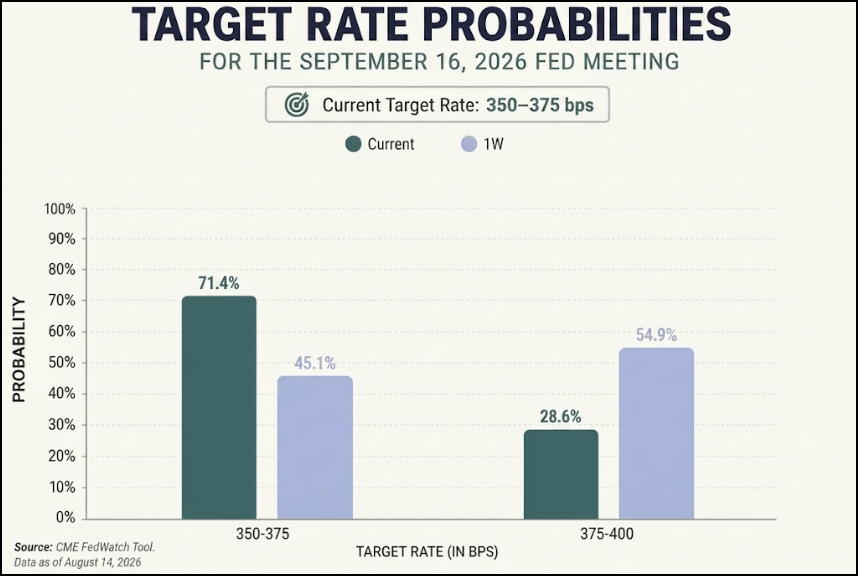
Headline consumer prices increased 0.1% month over month in July, following a 0.4% decline in June, while annual CPI eased to 3.4% from 3.5%. The relatively benign inflation data contributed to lower Treasury yields and reduced market expectations for additional monetary tightening.At present, approximately 71% of traders expect interest rates to remain unchanged at the next FOMC meeting.For equity investors, the combination of moderating inflation and resilient corporate earnings has provided a more supportive environment for risk assets. Lower yields can particularly benefit growth-oriented companies whose valuations are more sensitive to changes in interest rates.
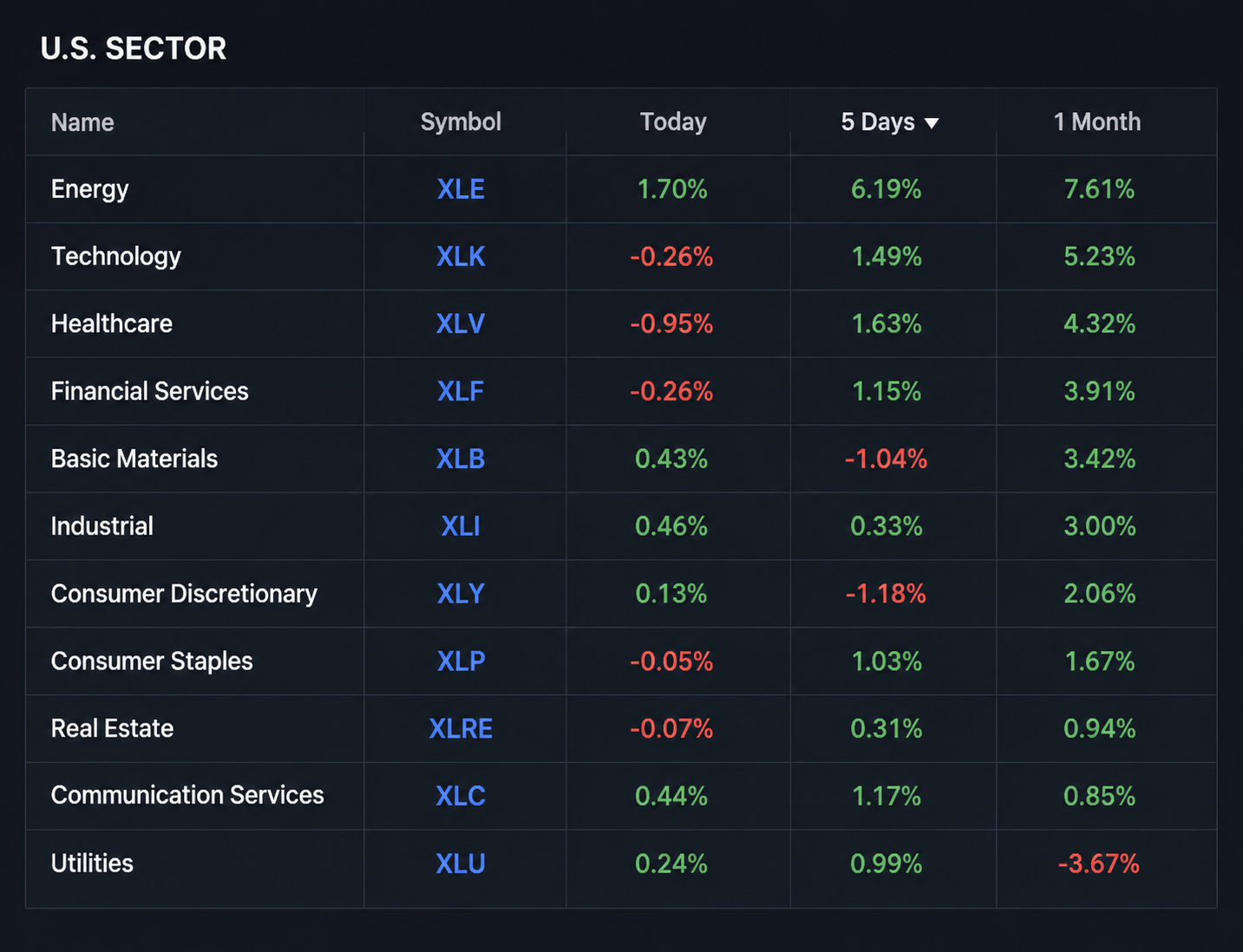
Technology was one of the clearest beneficiaries.The sector gained as investors focused on continued AI infrastructure demand and constructive forecasts from companies such as CoreWeave and Nebius. Importantly, market participants are becoming increasingly selective within the AI theme. Companies demonstrating measurable revenue growth, expanding customer demand, and tangible infrastructure exposure are receiving stronger support than businesses benefiting solely from broad AI enthusiasm.
Technology has now become the second-best-performing sector over the past month, reflecting the renewed strength of the AI investment narrative. Energy, meanwhile, remained driven more by geopolitical developments than by the broader equity rally. Crude prices moved higher earlier in the week as uncertainty surrounding Iran's demands, including sanctions relief, compensation, and security conditions, complicated expectations for a near-term reopening of the Strait of Hormuz.
Another encouraging development has been the improvement in overall market breadth. The equal-weight S&P 500 has recently overtaken the market-cap-weighted index, suggesting that participation in the rally is expanding beyond the largest companies.This distinction is important. A market advance supported by a broader range of companies is generally a healthier signal than a rally concentrated within a handful of mega-cap stocks.
The key question for the coming weeks is whether cooling inflation can continue supporting expectations for stable or lower interest rates without indicating a significant deterioration in economic activity. For now, the combination of easing price pressures, resilient corporate earnings, and renewed AI investment enthusiasm continues to support a constructive risk environment.
Arakawa Quant's Quantitative Perspective
When market leadership changes rapidly, price movements can often become disconnected from underlying business performance. This is where a systematic framework becomes particularly valuable. Arakawa Quant focuses on evaluating companies through a combination of fundamental strength, earnings trends, valuation, profitability, momentum, and changing market expectations. Rather than treating short-term price movements as a complete representation of investment quality, the objective is to identify whether the underlying business case is strengthening or weakening. The recent market environment provides a good example of why this distinction matters. Technology stocks experienced significant volatility during the previous weeks, yet many companies continued to report strong demand related to AI infrastructure, data centers, optical connectivity, and advanced computing. As market sentiment improved, these companies were among the first to recover.
For long-term investors, this highlights the importance of maintaining discipline during periods of elevated volatility. A temporary decline in a fundamentally strong company does not necessarily mean that its long-term investment thesis has deteriorated. At the same time, systematic analysis should not be interpreted as blindly holding every declining stock. Changes in profitability, earnings expectations, valuation, or business fundamentals can materially alter an investment case. The goal is therefore to distinguish between short-term sentiment-driven weakness and genuine deterioration in fundamentals.
Sandisk: AI-Driven NAND Strategy Comes Into Focus
One of the strongest performers across the portfolio this week was Sandisk (SNDK), which gained more than 20%following its Investor Day. The company presented a long-term financial framework centered around the continued expansion of AI-related demand for NAND storage. Management is targeting mid-to-high-teens revenue growth, approximately 80% adjusted gross margins, and around 75% adjusted operating margins over fiscal 2028–2030. The company also expects adjusted free-cash-flow margins of approximately 50% and plans to return 100% of excess cash to shareholders after funding required business investments.
The significance of Sandisk's outlook extends beyond the company's near-term share-price performance. As AI infrastructure expands, storage requirements are also increasing. The growth of data centers, accelerated computing, and AI workloads creates additional demand for high-performance memory and storage solutions. Sandisk's strategy therefore provides another example of how the AI investment cycle extends beyond traditional GPU manufacturers. The market reaction suggests that investors are increasingly rewarding companies that can demonstrate a clear connection between AI investment and future revenue and profitability.
Portfolio Leaders Broaden Beyond Technology
Sandisk was not the only strong performer during the week.
Twilio (TWLO) gained more than 20% following strong quarterly results and an improved outlook. The company's performance reinforced investor confidence in its growth trajectory and AI-enabled communications platform.
Outside technology, Par Pacific Holdings (PARR) continued to benefit from strong refining margins, while Coeur Mining (CDE) gained alongside strength in precious metals.
Credo Technology (CRDO) also continued to advance as demand for AI data-center connectivity remained strong.
The breadth of these gains is notable. While technology and AI infrastructure remain important sources of market leadership, recent performance suggests that opportunities are becoming more diversified across different industries and business models. This is consistent with a broader improvement in market breadth.
Pullbacks Remain Concentrated and More Measured
Declines across the portfolio were comparatively modest during the week.
Millicom International Cellular (TIGO) led the weaker performers after investors took profits following its strong post-earnings rally. AppLovin (APP) also declined after quarterly revenue came in below expectations.
Meanwhile, Argan (AGX), Allstate (ALL), and Corporación América Airports (CAAP) recorded relatively limited weekly losses.
The divergence between the strongest and weakest performers once again demonstrates why portfolio-level analysis is important. Even during a broad market rally, individual companies can move sharply in either direction based on earnings results, valuation, expectations, or positioning. For a quantitative strategy, these differences provide important information. Momentum can identify where capital is flowing, while earnings and profitability trends help determine whether that momentum is supported by underlying fundamentals.
Portfolio Update: Lumentum Rating Change
Another notable portfolio development involved Lumentum (LITE).
Following its latest results, the stock's rating was downgraded to Hold after its Profitability Grade fell to D-. The company delivered a strong operating quarter, but the conversion of a convertible note into equity affected reported GAAP EPS and caused reported return on equity to fall sharply to approximately negative 240%. The deterioration in reported ROE had a significant impact on the company's profitability assessment and ultimately contributed to the rating change. This illustrates an important aspect of systematic investment analysis: a strong quarter alone does not automatically translate into a stronger overall rating. Multiple factors must be considered simultaneously, and changes in profitability metrics or capital structure can materially influence the broader assessment.
What to Watch Next
The next stage of earnings season will provide additional information about the strength of corporate demand and the sustainability of the current market rebound.
Three additional Arakawa Quant portfolio companies are scheduled to report results next week, including Fabrinet (FN). As a major precision optical-manufacturing partner, Fabrinet's results could provide another useful indicator of demand for AI data centers, optical connectivity, and related infrastructure. Investors will also monitor results from major retailers including Walmart (WMT) and Target (TGT). Their earnings and management commentary could offer fresh insight into consumer sentiment, household spending, and the broader outlook for the Consumer Discretionary sector.
Beyond earnings, interest-rate expectations and geopolitical developments remain important variables. The market has recently benefited from softer inflation and renewed confidence in technology spending, but this optimism could be tested if upcoming economic data changes expectations for monetary policy or if geopolitical tensions trigger another sharp move in energy prices. For investors, the current environment reinforces the value of remaining selective rather than simply following broad market momentum.
Arakawa Quant Outlook
The latest rebound has improved the market's short-term risk appetite, but the underlying environment remains highly dynamic. Softer inflation has reduced pressure on interest-rate expectations, AI investment continues to support technology and infrastructure companies, and improving market breadth suggests that participation is becoming more diversified.
At the same time, valuations, geopolitical risks, monetary policy, and changing earnings expectations can still generate significant short-term volatility. Arakawa Quant therefore continues to focus on the interaction between fundamentals, valuation, profitability, earnings revisions, and price momentum rather than relying on any single market signal. The strongest opportunities may not always be found among the stocks experiencing the largest short-term gains. In many cases, the more important question is whether a company's earnings trajectory, business fundamentals, and long-term growth potential remain strong enough to justify continued investor attention. As the earnings season progresses, these factors will remain central to how we evaluate market opportunities and portfolio developments.
In an era of information overflow, alpha lies in asymmetric execution, not intuitive consensus
Skye
SMC Market Analyst
Subscribe to our newsletter
Get the insider insights you need to scale, straight to your inbox.



Decode the Market. Quantify Your Edge.
Elite quantitative models and real-time execution signals. Trade with institutional power.

Copyright © 2026 Hong Kong Arakawa Limited. All rights reserved.


%2C%20Color%3DNegative.svg)