First
Last
email@email.com
Momentum Trading: Mastering the "Structure + Momentum" Dual-Confirmation
Strategy
April 25, 2026

Skye
Decoding institutional Liquidity Sweeps
Abstract
The common struggle of being stopped out just before reaching profit targets in day trading often stems from a lack of momentum confirmation. This article outlines a 5-minute momentum trading strategy based on the 20 EMA and MACD. By applying a dual-confirmation principle—Structure + Momentum—you can effectively filter out false breakouts and optimize risk-reward ratios using dynamic trailing stops.
If you find yourself being stopped out just points away from your profit target, it isn't just a streak of bad luck—it's a lack of momentum confirmation. Price action alone often triggers false signals in ranging markets. The core philosophy of this 5-minute momentum strategy is simple: Do not predict the market; wait for the market to signal its intent, then participate.
Tools and Logic:
20-Period Exponential Moving Average (20 EMA):
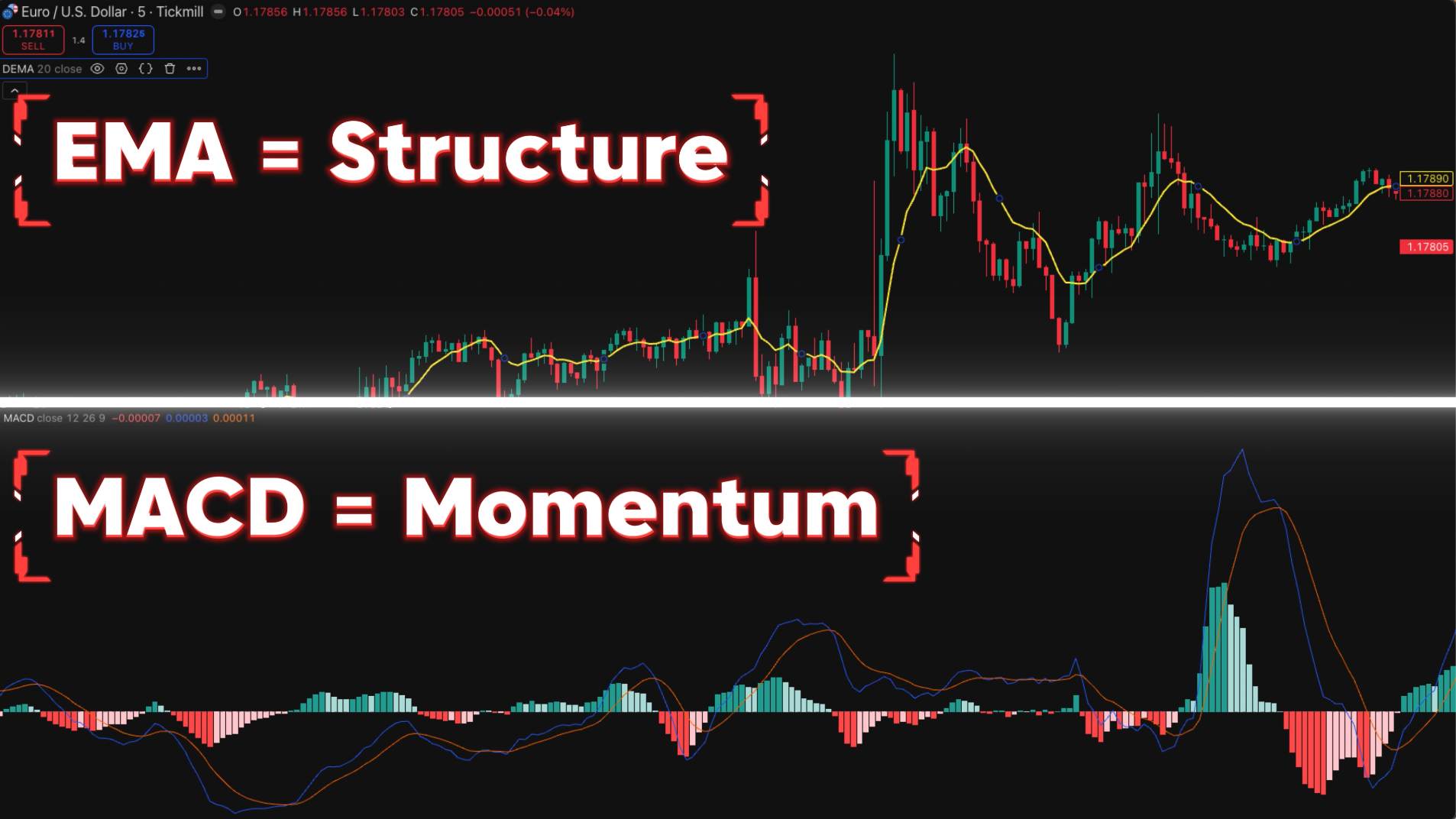
- Function: Defines the short-term market structure. The EMA reacts quickly to recent price action, making it ideal for the fast-paced 5-minute timeframe. It helps traders identify the prevailing bullish or bearish structure.
- Application: Price above the EMA suggests a bullish structure; price below the EMA suggests a bearish structure.
MACD (Settings: 12, 26, 9):
- Function: Determines momentum. We focus specifically on the MACD Histogram to assess whether a potential reversal is backed by genuine volume and strength, rather than a fleeting spike.、
- Application: A Histogram flip from negative to positive (above the zero line) signals bullish momentum; a flip from positive to negative (below the zero line) signals bearish momentum.
Dual-Confirmation Principle (Structure + Momentum):
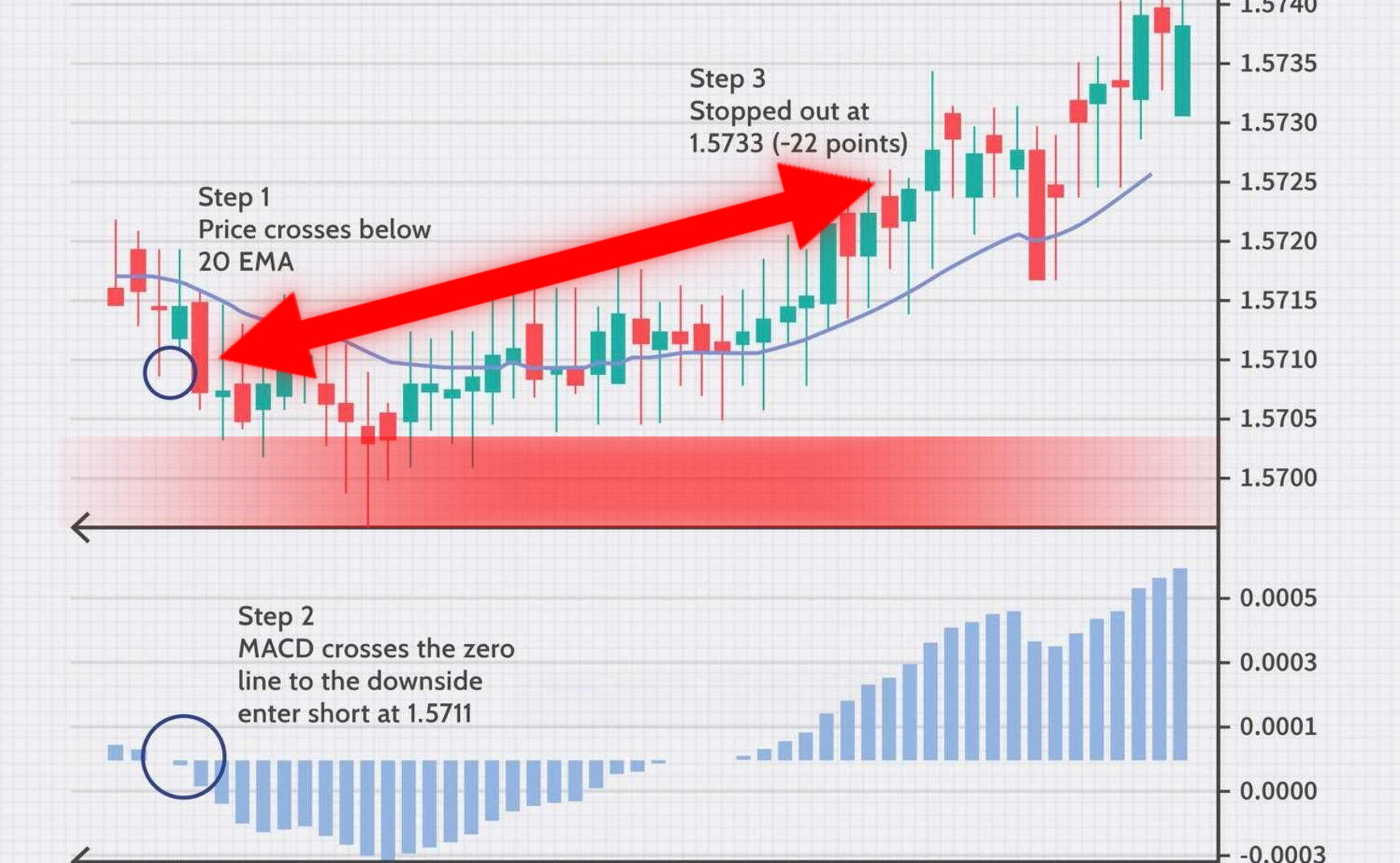
- First Filter (Structure): A price break of the 20 EMA serves as an early warning signal that the market may be preparing for a move.
- Second Filter (Momentum): A trade is only triggered when the MACD Histogram confirms the move by crossing the zero line.
- Core Discipline: If the structure breaks but momentum does not confirm, stay out.

Case Study:
Consider a live example on the EUR/USD 5-minute chart:
- Phase 1 (Wait Zone): Price breaks above the 20 EMA, forming a bullish structural setup. However, the MACD Histogram remains below the zero line, indicating that bearish momentum has not yet dissipated and bullish strength has not taken control. Entering a long position here would risk buying a false breakout at the peak.
- Phase 2 (Confirmation Zone): Several minutes later, as buying pressure continues to build, the MACD Histogram flips from negative to positive, crossing above the zero line. At this moment, both conditions are met: structure (price above EMA) and momentum (MACD positive). This is the official trigger point to enter the trade.
- Phase 3 (Position Management): After entry, price moves smoothly in the expected direction, reaching the initial profit target.
Position Sizing and Risk Management:
Tiered Profit Taking:
- When the price reaches a 1:1 risk-reward ratio (floating profit equals initial stop-loss distance), close half of the position immediately to lock in risk-free profits.
- Move the stop-loss on the remaining half to the entry price (break-even). From this point forward, the trade carries no risk of principal loss.
Dynamic Trailing Stop:
- For the remaining half position, abandon fixed-profit targets. Instead, use the 20 EMA combined with a dynamic buffer (e.g., EMA ± 15 pips) as a trailing stop.
- In a bullish trade, as long as price stays above the 20 EMA, hold the position. In a bearish trade, as long as price stays below the 20 EMA, hold the position. This allows the trade to capture extended trends until a clear reversal signal emerges.
Risk Mitigation:
No strategy is invincible. This system can struggle in low-volatility, choppy markets where breakouts lack follow-through. To mitigate this:
Avoid trading during low-volatility sessions or highly compressed consolidation phases.
Filter your signals by aligning them with the dominant trend of higher timeframes (e.g., 1H or 4H).
Trading at a professional level isn't about being right every time; it's about filtering out noise through rigorous structural and momentum verification, ensuring you are positioned correctly when the market finally moves.
In an era of information overflow, alpha lies in asymmetric execution, not intuitive consensus.
Skye
SMC Market Analyst
Subscribe to our newsletter
Get the insider insights you need to scale, straight to your inbox.




Decode the Market. Quantify Your Edge.
Elite quantitative models and real-time execution signals. Trade with institutional power.

Copyright © 2026 Hong Kong Arakawa Limited. All rights reserved.


%2C%20Color%3DNegative.svg)