First
Last
email@email.com
Q2 Earnings Season: Strong Results Highlight Resilient Fundamentals Across Arakawa Quant
Market
August 6, 2026


Skye
Decoding Institutional Liquidity Sweeps
Summary
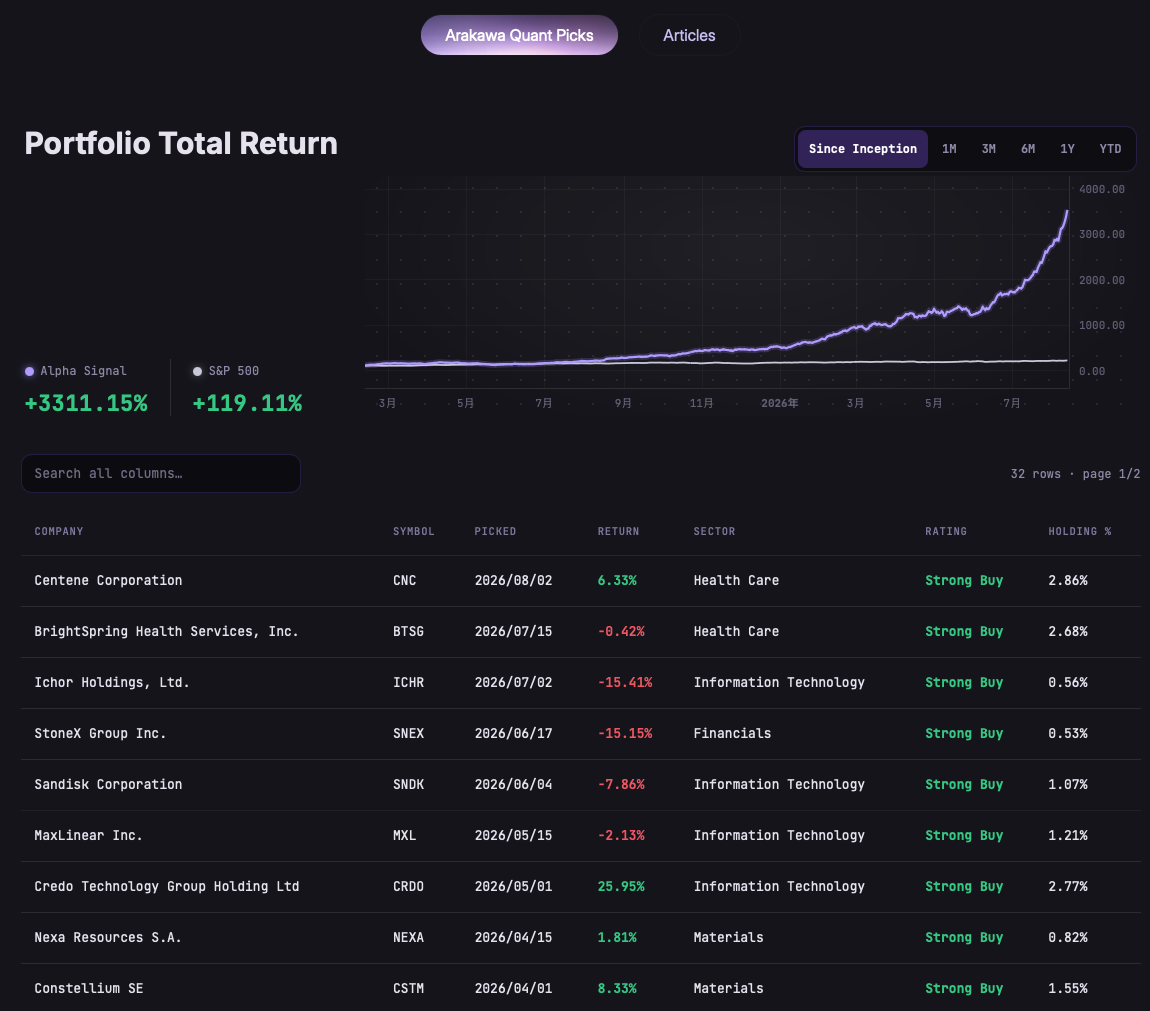
- More than half of the companies tracked in the Arakawa Quant portfolio have reported second-quarter results, with 32 companies reporting and 75% beating earnings expectations.
- Wayfair and Twilio delivered standout quarters, with both stocks gaining more than 20% following strong earnings and improved forward guidance.
- Strong results across technology, healthcare, energy, industrials, and financials have helped offset the volatility that affected semiconductor and AI-related stocks throughout July.
- Several companies reported both revenue and EPS above expectations, highlighting continued strength in AI infrastructure, healthcare services, specialty manufacturing, energy, and other growth-oriented areas.
- Despite recent market volatility, the underlying earnings picture remains constructive, reinforcing the importance of focusing on business fundamentals, valuation, and forward expectations rather than short-term price movements.
Q2 Earnings Season Brings Strong Results Across the Portfolio
The second-quarter earnings season is increasingly providing investors with a clearer picture of the underlying health of corporate America. While July was characterized by significant volatility across technology, semiconductor, and AI-related stocks, the latest earnings reports suggest that many companies continue to deliver strong revenue growth, expanding profitability, improving cash generation, and constructive forward guidance.
Within the Arakawa Quant portfolio, 32 companies have reported second-quarter results so far, with 24 of them, or 75%, exceeding earnings expectations.
The strength has not been limited to a single industry. Information Technology, Healthcare, Energy, Industrials, Financials, and selected Consumer Discretionary companies have all produced notable results during the current reporting cycle.
Several companies also delivered what investors often consider the strongest form of earnings beat: exceeding expectations on both revenue and earnings. Celestica, MaxLinear, BrightSpring Health Services, Par Pacific Holdings, and Sterling Infrastructure were among the companies that delivered particularly strong quarterly results.
This breadth is important because it suggests that the recent volatility in equity markets has not been accompanied by a broad deterioration in corporate fundamentals. Instead, investors appear to be differentiating more aggressively between businesses that are continuing to improve their operating performance and companies whose valuations or growth expectations have become increasingly difficult to justify.
For quantitative investors, this distinction matters. A short-term decline in share price does not necessarily indicate that the underlying investment thesis has deteriorated. Conversely, a rising stock price does not automatically mean that fundamentals have improved. Earnings growth, profitability, valuation, revisions, and price momentum need to be evaluated together.
The current earnings season is therefore becoming an important test of whether recent market weakness represents a temporary valuation reset or a more fundamental deterioration in corporate earnings.
Wayfair and Twilio Stand Out Following Strong Earnings
Two of the most notable performers during the latest earnings cycle were Wayfair (W) and Twilio (TWLO).
Wayfair shares surged as much as 30% after the company reported second-quarter revenue and earnings above analyst expectations.
The company generated 7.5% year-over-year net revenue growth, while U.S. revenue increased nearly 9%. Its specialty brands performed particularly well, growing approximately 20%, with Perigold, Wayfair's luxury segment, expanding more than 35% year over year.
Perigold is becoming an increasingly important component of Wayfair's long-term growth strategy. Management highlighted the brand's consistent double-digit growth since launch and indicated that the business has the potential to become a multibillion-dollar operation over the coming years.
The significance of the result extends beyond revenue growth. Wayfair delivered a 30% gross margin and a 6.9% adjusted EBITDA margin, its strongest level since 2021. Strong free cash flow and continued balance-sheet improvements further strengthened the quarterly report.
The company has also continued reducing financial risk by replacing convertible debt with high-yield notes while preparing for potential share repurchases. For investors, the combination of improving margins, stronger cash generation, and a more flexible balance sheet provides additional support for the company's recovery story.
For the third quarter, management expects revenue growth in the high-single-digit range, with gross margin expected to remain between 29.5% and 30.5%.
Twilio delivered an equally impressive quarter.
Shares rose more than 20% following a substantial earnings and revenue beat, supported by accelerating organic growth and stronger-than-expected guidance. Revenue increased 22% year over year, while non-GAAP operating income reached a record $285 million and non-GAAP gross profit reached $736 million.
More importantly, management raised its full-year organic growth outlook from 9.5%-10.5% to 13%-13.5%, while also guiding third-quarter revenue above market expectations.
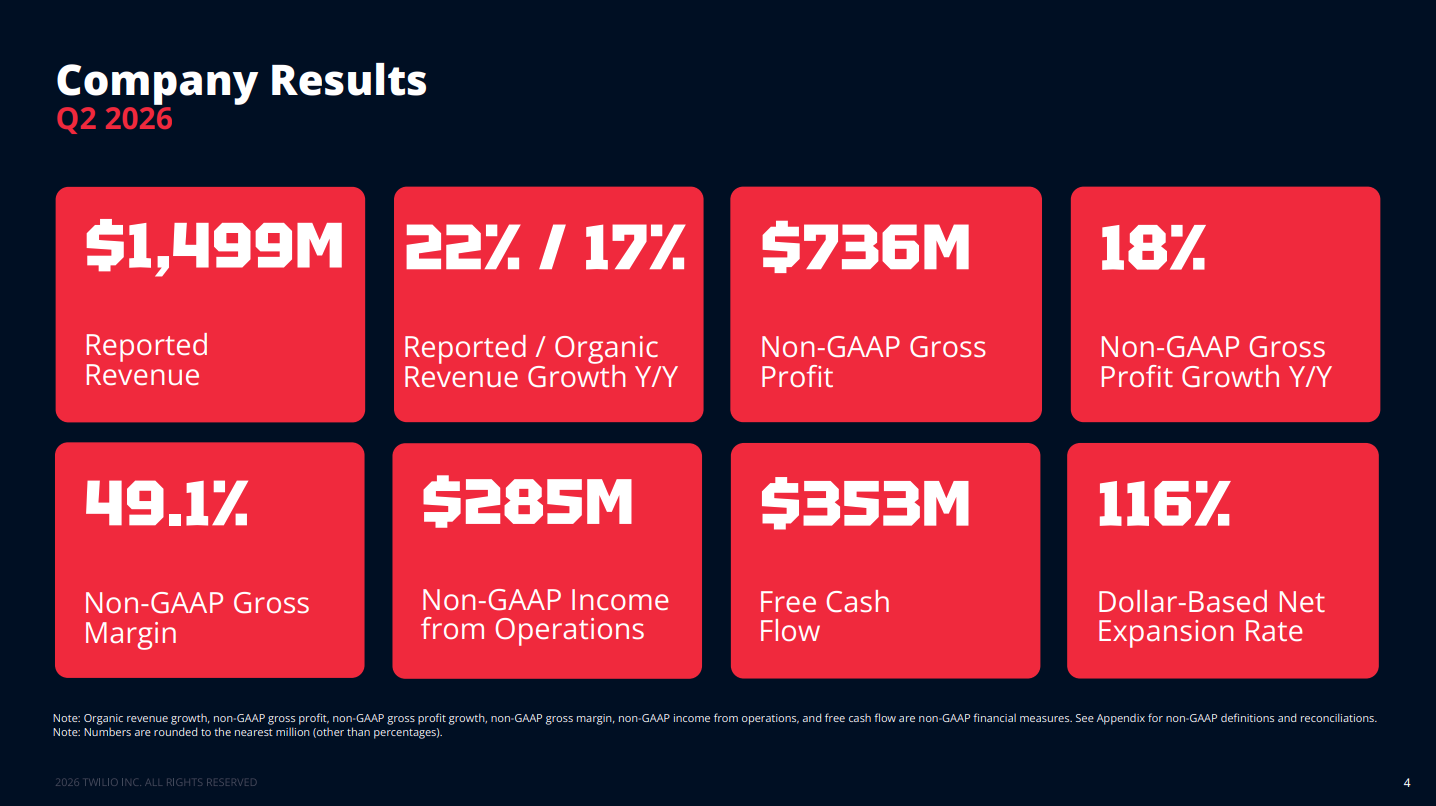
The combination of accelerating growth, improving profitability, and stronger guidance helped reinforce the investment case surrounding Twilio's AI-enabled communications platform. The reaction in the stock also demonstrates how quickly market sentiment can change when a company provides evidence that growth expectations were too conservative.
AI Infrastructure Remains a Major Growth Driver
The continuing strength of AI infrastructure spending remains one of the most important themes running through this earnings season.
Hyperscalers continue to commit substantial capital toward data centers, computing capacity, networking infrastructure, optical connectivity, and memory. The benefits are increasingly spreading beyond the largest semiconductor companies to a much broader group of suppliers.
Celestica (CLS) delivered record results, with revenue increasing 62% year over year to approximately $4.7 billion. Adjusted EPS reached $2.54, while adjusted operating margin expanded to a record 8.2%.
The company's performance was driven by accelerating demand for AI and networking infrastructure, with particularly strong growth across its CCS and ATS businesses.
Management also raised its 2026 revenue outlook to approximately $20.5 billion.
The stock nevertheless experienced pressure as investors digested a proposed $3 billion equity offering at a significant discount. The company intends to use the proceeds to accelerate its expansion in AI infrastructure.
This creates an interesting distinction between operating fundamentals and short-term market behavior. The capital raise may create near-term dilution concerns, but the underlying reason for the investment is the company's expectation of continued demand for AI infrastructure.
TTM Technologies (TTMI) also reported record second-quarter results. Revenue increased 37% year over year, while adjusted EPS reached a record $0.99.
The company's data-center and networking business was particularly impressive, with revenue increasing 91% year over year and now representing approximately 40% of total revenue. Aerospace and defense revenue also increased 14%.
Management expects third-quarter revenue and earnings to remain above consensus expectations and raised its 2026 full-year revenue outlook to approximately $4.4 billion.
MaxLinear (MXL) delivered another strong quarter, with revenue increasing 55% year over year. Its infrastructure business became the company's largest segment, growing an impressive 145%.
Growing demand for 800G Keystone-powered optical data-center solutions also led management to increase its 2026 optical revenue outlook to approximately $210 million-$230 million.
Sandisk (SNDK) reported record quarterly revenue and gross margin, with both revenue and earnings exceeding expectations. Strong NAND demand and higher product pricing remained key drivers.
Taken together, these results provide further evidence that hyperscalers remain committed to heavy AI infrastructure spending.
Demand for high-speed networking, optical connectivity, memory, data-center equipment, and related hardware remains an important growth driver across the technology supply chain.
For investors, this means the AI investment cycle should not be viewed purely as a semiconductor story. The economic impact is increasingly spreading across the broader infrastructure ecosystem.
Industrial Infrastructure Continues to Benefit From AI Investment
The AI investment cycle is also creating opportunities outside traditional technology companies.
Sterling Infrastructure (STRL) delivered one of the strongest industrial results in the portfolio. Second-quarter revenue increased 90% year over year, while adjusted diluted EPS increased 116%.
The company's backlog also increased 116%, with its E-Infrastructure segment leading the expansion. E-Infrastructure revenue increased an extraordinary 192%, while key data-center, manufacturing, and semiconductor projects now account for more than 92% of the segment's backlog.
Management raised its full-year 2026 guidance and now expects revenue of approximately $4.0 billion-$4.15 billionand adjusted EPS of $19.70-$20.30.
These results demonstrate how AI infrastructure spending is creating opportunities well beyond chip manufacturers.
A new generation of data centers requires enormous amounts of electrical infrastructure, construction capacity, cooling systems, specialized engineering services, and grid-related investment. As hyperscalers continue expanding their computing capacity, companies positioned further down the infrastructure chain can also benefit.
Powell Industries (POWL) reported record new orders, pushing backlog to approximately $2.4 billion. Although quarterly revenue and EPS were slightly below expectations, management pointed to strong long-term demand from U.S. LNG, utilities, grid modernization, data centers, and AI infrastructure.
The contrast between quarterly results and future order visibility is an important reminder that investors should not evaluate industrial companies solely on one quarter's reported earnings. Backlog, order growth, margin trends, and future capacity can provide important signals about the sustainability of the earnings cycle.
Healthcare Fundamentals Remain Strong
Healthcare was another area where earnings demonstrated considerable resilience.
BrightSpring Health Services (BTSG) reported second-quarter revenue growth of 23%, approximately 6% above consensus. Adjusted EPS reached $0.45, roughly 13% above expectations, while adjusted EBITDA increased 44% to $206 million.
Management subsequently raised its 2026 guidance, now expecting full-year revenue of approximately $15.1 billion-$15.425 billion and adjusted EBITDA of $820 million-$845 million.
Centene (CNC) also delivered a double beat in the second quarter. The company raised its 2026 adjusted EPS guidance, supported by improved expectations for Marketplace pretax margins and stronger profitability within its PDP business.
Incyte (INCY) reported revenue and earnings above expectations. Excluding a $246 million non-cash CMS settlement benefit, total net sales still increased 17% year over year, while its core product Jakafi continued to perform strongly.
The healthcare results reinforce a broader theme: companies with improving margins, strong cash generation, and clear structural demand drivers can continue producing attractive operating results even when the broader market is experiencing substantial volatility.

For quantitative investors, healthcare also provides diversification from the technology-heavy AI trade. When technology valuations become more sensitive to interest rates or positioning, companies with independent earnings drivers can provide a different source of portfolio exposure.
Energy and Materials Remain Highly Sensitive to Commodity Prices
Energy and materials companies continued to experience a different earnings environment, where commodity prices and operating conditions played a significant role.
Par Pacific Holdings (PARR) reported particularly strong second-quarter results, with both revenue and earnings exceeding expectations.
The company benefited from unusually favorable refining economics, with crack spreads and integrated refining margins remaining significantly above historical levels.
In precious metals, Kinross Gold (KGC) exceeded earnings expectations, supported by higher realized gold prices, disciplined cost management, and strong margins.
Newmont (NEM) also exceeded earnings expectations, although revenue was below forecasts due partly to earthquake-related disruption and lower ore grades at certain operations.
Meanwhile, Nexa Resources (NEXA) reported revenue above expectations despite an EPS miss. Net revenue increased 28% year over year, while adjusted EBITDA surged 78%, supported by higher zinc prices, stronger by-product contributions, lower operating costs, and improving operations in Peru.
Not every materials company benefited from the same environment.
Coeur Mining (CDE) and SSR Mining (SSRM) both faced pressure as operating factors, production levels, realized prices, and higher costs weighed on results.
This divergence highlights why commodity exposure alone is not enough to determine an investment opportunity. Production quality, cost structure, asset characteristics, balance-sheet strength, and management execution can produce substantially different outcomes even among companies exposed to the same commodity.
Financial Companies Continue to Show Resilient Earnings
Financial stocks also delivered a number of strong results.
Allstate (ALL) reported second-quarter revenue growth of 11.8% and net income of $3.2 billion, exceeding expectations. Strong underwriting performance and a 33.8% increase in net investment income helped drive the result.
Manulife Financial (MFC) reported second-quarter results slightly above consensus, with earnings increasing 16% year over year. All three major insurance businesses delivered double-digit revenue growth, while core earnings in Asia increased 21%.
StoneX (SNEX) delivered particularly strong results for its fiscal third quarter. Net operating revenue increased 47%, net income more than doubled to $127.9 million, and diluted EPS reached $1.00. Quarterly ROE reached 18.4%, well above the company's 15% target.
Synchrony Financial (SYF) produced a mixed quarter. Net interest income and overall sales increased only around 2%, while higher payment rates and lower late-fee income created pressure on revenue and net interest margins.
However, stronger credit metrics, higher loan receivables, and disciplined expense management helped adjusted diluted EPS reach $2.59, approximately 20% above analyst expectations.
The financial results demonstrate another important feature of the current earnings cycle: strong companies can continue to outperform expectations even when their broader industry faces macroeconomic uncertainty.
What the Earnings Season Is Telling Investors
The latest results provide a more nuanced picture of the market than price movements alone might suggest.
Technology and semiconductor stocks experienced significant volatility throughout July, but many companies within the AI infrastructure ecosystem continue to report strong demand, rising revenue, and improving profitability.
At the same time, healthcare, industrials, energy, and financial companies are demonstrating that earnings growth is not concentrated exclusively within large technology stocks.
The most important takeaway is therefore not simply that earnings are beating expectations. It is that the dispersion between individual companies is becoming increasingly important.
Some businesses are producing accelerating revenue growth, expanding margins, stronger cash generation, and higher guidance. Others are facing weaker demand, rising costs, or expectations that have become too difficult to meet.
For a quantitative investment framework, this distinction is critical.
Arakawa Quant evaluates companies through the interaction of fundamental performance, valuation, earnings expectations, and market behavior. A strong quarterly result can provide confirmation that a company's underlying business is moving in the right direction, while a weak report may indicate that previously optimistic expectations need to be reassessed.
This approach is particularly relevant during earnings season because stock prices can move sharply in either direction even when the headline earnings number appears relatively straightforward.
A company can beat estimates and still fall if expectations were already too high. Another company can deliver only a modest beat but rally strongly if investors had previously positioned for a much weaker result.
Understanding this difference between reported performance and market expectations is essential when evaluating earnings-driven price movements.
Arakawa Quant Outlook
The latest earnings reports suggest that corporate fundamentals remain considerably more resilient than recent market volatility might imply.
With 75% of reporting companies exceeding earnings expectations, the current earnings season provides encouraging evidence that many businesses continue to generate strong growth despite an uncertain macroeconomic environment.
At the same time, the wide range of outcomes across individual companies shows why selectivity remains important. Strong AI infrastructure demand is benefiting companies such as Celestica, TTM Technologies, MaxLinear, and Sterling Infrastructure, while healthcare companies such as BrightSpring and Centene are benefiting from their own structural growth drivers.
The market may remain volatile as investors reassess valuations, interest-rate expectations, and the sustainability of AI-related spending. But for longer-term investors, periods of volatility can also reveal which companies have genuine fundamental support behind their valuations.
The next phase of earnings season will therefore be important not only for determining whether corporate earnings remain strong, but also for understanding whether current valuations are supported by the pace of future growth.
In an era of information overflow, alpha lies in asymmetric execution, not intuitive consensus.
Skye
SMC Market Analyst
Subscribe to our newsletter
Get the insider insights you need to scale, straight to your inbox.




Decode the Market. Quantify Your Edge.
Elite quantitative models and real-time execution signals. Trade with institutional power.

Copyright © 2026 Hong Kong Arakawa Limited. All rights reserved.


%2C%20Color%3DNegative.svg)