
Search All
Quantitative Resilience Amid Macro Shocks: ArakawaQuant Weekly Market Recap & Portfolio Review


1. Summary
Tech Volatility & Rebound: Last Friday’s tech volatility spilled into this week, with stocks selling off on Tuesday and Wednesday before growth and AI names staged a strong late‑week rebound.
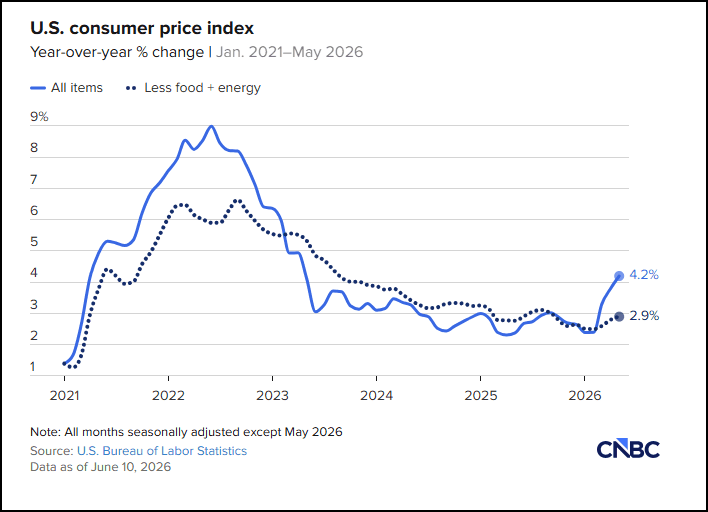
Headline Inflation Spikes: Headline CPI hit 4.2% on a 0.5% monthly gain, driven by a surge in energy prices, while softer core CPI helped temper fears of a full inflation re‑acceleration.
Geopolitical Relief: Geopolitical risk stayed front and center, but easing U.S.–Iran tensions into the G7 drove a pullback in crude and helped stabilize sentiment across risk assets.
Secular Growth Validated: The SpaceX IPO reignited enthusiasm for secular growth, with its massive valuation validating long-term themes in space, satellites, launch, and AI-adjacent tech.
Buying the Quant Dip: The ArakawaQuant portfolio has historically seen market volatility and drawdowns coincide with highly attractive entry points into high-quality names.
2. Market Whipsaw: CPI, Middle East Tensions, and the SpaceX Effect
Fellow Investors,
It’s been a wild week for markets, with volatility from last Friday’s tech-led selloff carrying through and driving sharp swings in both directions. Investors have been balancing a hotter-than-expected inflation print, daily developments in the Middle East, and renewed risk appetite sparked by the blockbuster SpaceX IPO.
Tech and chip names tried to stabilize on Monday, with the Nasdaq and key AI beneficiaries bouncing as dip‑buyers stepped in after last week’s rout, but the rebound was short-lived. By Tuesday and into mid‑week, higher yields and geopolitical stress reasserted themselves. Technology stocks resumed their slide as investors de‑risked ahead of the inflation data and reassessed how far valuations had run.
Wednesday’s CPI release sat squarely at the center of the week’s macro anxiety. Headline CPI rose 0.5% month‑over‑month and 4.2% year‑over‑year—the first move above 4% in three years. This was driven largely by a 3.9% monthly surge in energy that pushed the 12‑month gain in that category to 23.5%. Conversely, Core CPI was more benign at 0.2% month‑over‑month and 2.9% year‑over‑year, a touch softer than April, which helped temper fears of a true re‑acceleration in underlying inflation.
The conflict with Iran also contributed heavily to market volatility. After U.S. forces carried out new strikes in response to an American helicopter being shot down near the Strait of Hormuz, worries escalated that energy‑driven inflation could linger. By Friday, however, the U.S. and Iran were edging toward a potential peace deal, with officials hinting that an agreement might be signed around next week’s G7 summit in Europe. Markets quickly priced in the prospect of smoother shipping lanes: crude fell roughly 4% to the mid‑$80s, Brent slid a similar amount, and energy prices extended their decline.
As oil prices sold off, tech stocks found firm support on Friday. Enthusiasm around the monumental SpaceX IPO and its $1.7T valuation helped restore risk appetite in growth and AI‑adjacent names. The deal is being widely viewed across the industry as a fresh validation of the long‑term secular story in space, satellites, and launch infrastructure.
Looking ahead to next week, markets will be digesting fresh U.S. retail sales and housing data, which should help clarify how resilient the consumer and broader economy really are. At the same time, the G7 summit will keep Middle East risks, energy policy, and shipping routes squarely in focus.
3. ArakawaQuant's Quantitative Edge & Performance Review
By sticking to a disciplined, rules‑based process, ArakawaQuant is designed to strip emotion out of stock selection and focus purely on fundamentals. The strategy zeroes in on high‑quality names that screen well across multiple core factors, including Valuation, Growth, Profitability, Momentum, and Analyst Revisions.
This systematic approach has been incredibly powerful in practice: 17 open positions (across 15 individual stocks) have more than doubled, and the core portfolio is up 415.28% since inception, compared with a 95.44% gain for the S&P 500.
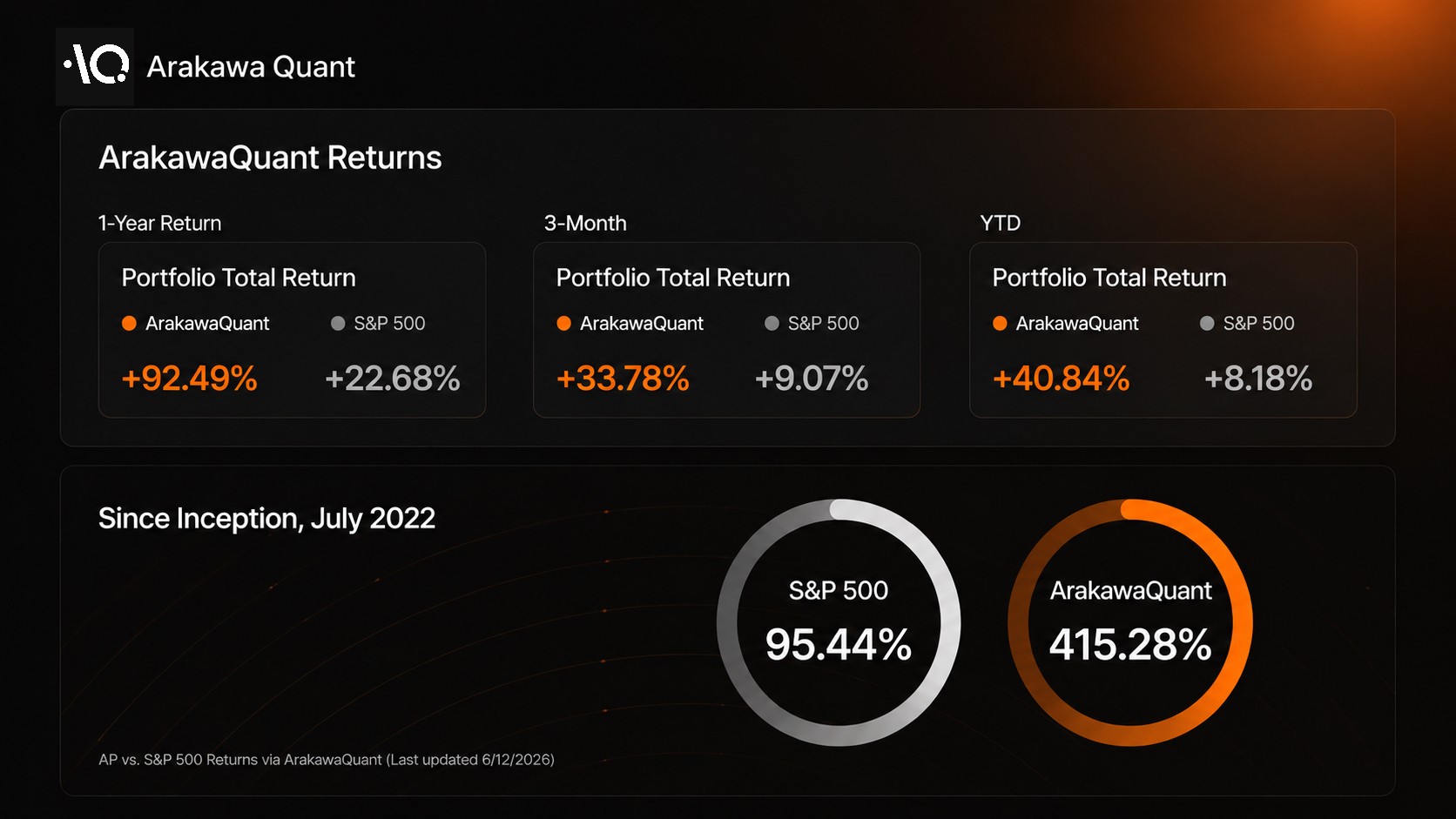
The ArakawaQuant portfolio has already clawed back a substantial portion of the pullback that started with last Friday’s volatility spike, even amid sharp swings in core infrastructure and AI names:
Top Performers: Credo Technology (CRDO) led the recovery as investors rotated back into high‑speed connectivity and data center winners, leveraging ongoing AI capex. Brinker International (EAT) was another notable winner, with the market rewarding its strong fundamental story and execution.
Under Pressure: As expected, this week’s bottom performers were largely concentrated in technology and AI infrastructure names, as investors took profits following strong recent run-ups. Nexa Resources (NEXA) also weighed on performance, reflecting broader weakness across the precious metals space. Additionally, the ongoing conflict in Iran drove up energy and operating costs, temporarily pressuring margins across affected groups.
4. Embracing the Barbell Strategy for Future Volatility
Stocks with solid fundamentals tend to heavily outperform following selloffs because their earnings resilience, balance sheet strength, and competitive positioning become more apparent as weaker companies struggle. As markets stabilize, institutional capital typically rotates back into these higher-quality businesses.
That said, several potential volatility catalysts remain on the horizon, making it important to position portfolios for a wide range of outcomes. One highly effective way to do this is through a barbell approach.
In recent weeks, we have continuously highlighted the value of balancing higher-growth opportunities—such as our core ArakawaQuant names—with more stable, dividend-paying defensive stocks. This combination helps dampen overall portfolio volatility while providing a steady stream of income. While dividends are not the primary focus of the ArakawaQuant growth strategy, a number of our holdings do provide excellent income, with the portfolio’s average forward yield of 1.43% coming in well above the S&P 500’s 0.97%.
5. Conclusion
In a macro environment defined by rapid shifts, following a data-driven, systematic quantitative model remains the ultimate mechanism to eliminate emotional bias from your execution. Keeping your eyes glued to core fundamentals will continue to separate short-term market noise from genuine, long-term alpha.
Subscribe to the official ArakawaQuant blog today to get institutional-grade quantitative insights, weekly market recaps, and strategic portfolio updates delivered straight to your inbox!